
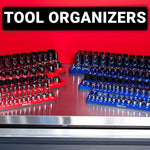
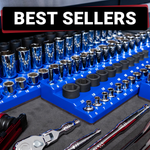






You feel it the second a job slows down - the 10mm is missing, deep and shallow sockets are mixed together, and your drawer turns into a metal junk pile. That is exactly why use socket organizers is a question worth asking. In a real shop, on a service truck, or in a home garage that gets serious use, organization is not about looking tidy. It is about working faster, protecting your tools, and keeping your head in the repair instead of in the drawer.
A good socket set is an investment. If it lives loose in a drawer, it takes a beating every day. Sockets roll, chip, get buried, and disappear. Worse, they waste your time one small search at a time. That is how ten clean minutes turn into twenty messy ones.
Why use socket organizers instead of loose drawer storage?
Loose storage feels convenient at first because you can toss everything in and move on. The problem shows up later, usually when the job is already fighting you. You open the drawer, hunt for size markings, pull out the wrong drive, and sort through piles of chrome and impact sockets that all look the same from above.
Socket organizers fix that by giving every size a home. You can see what is there, what is missing, and what you need next. Instead of searching, you grab. Instead of guessing, you confirm at a glance. That one change matters more than people think because mechanics and technicians do not lose time in big dramatic chunks. They lose it in constant little interruptions.
There is also a quality-control side to organization. When sockets are laid out in order, missing tools stand out immediately. That matters at the end of a job and before the next one starts. If a socket did not come back to its spot, you know right away. In a busy workflow, that is a lot better than finding out two days later that a critical size got left under a hood or rolled under a bench.
The real reason socket organizers improve workflow
The main benefit is speed, but not the kind people usually talk about. It is not only faster access to tools. It is faster thinking.
When your sockets are sorted by drive size, measurement system, depth, and often usage type, your brain spends less energy on tool management. You are not scanning a pile. You are following a pattern. Reach to the correct section, grab the size, and keep moving. That sounds simple because it is simple. Simple systems are what hold up under pressure.
In flat rate work, field service, and mobile repair, those seconds matter. So does consistency. If your organization system stays the same every day, your hand starts going to the right spot automatically. That kind of repeatable motion is what separates a smooth setup from one that constantly creates friction.
For serious DIY users, the gain is just as real. You may not bill labor hours, but your time still counts. If you only get a Saturday afternoon to work on a project, you do not want to burn it sorting sockets. A clean layout lets you spend that time turning wrenches instead.
Why visibility matters more than capacity
A lot of people focus on how many sockets an organizer can hold. Capacity matters, but visibility usually matters more. If you cannot identify sizes quickly, a packed organizer can still slow you down.
The best setups make it easy to read markings, separate SAE from metric, and keep shallow sockets distinct from deep ones. That clear visual layout reduces mistakes. It also helps when you are tired, rushing, or working in poor lighting. In those moments, the right organization system is doing real work for you.
Socket protection is part of the job
Sockets are built tough, but not every storage method treats them well. Loose sockets slam into each other, scrape against drawer bottoms, and get stacked under heavier tools. Over time, that creates unnecessary wear, harder-to-read markings, and more frustration than most people want to admit.
Socket organizers help prevent that abuse by keeping tools separated and secure. If you use specialty, impact, or frequently reached-for sockets, that matters even more. Good storage does not make a bad socket better, but it helps a good socket stay in working condition and easier to identify over the long haul.
Why use socket organizers in mobile and high-movement setups?
If your tools travel, organization stops being optional fast. Mobile mechanics, service techs, and anyone loading tools in and out of a truck already know what happens when sockets are stored loose. Every bump turns your drawer into a scramble.
A secure organizer helps keep your set where it belongs, even when the day is not smooth. It also cuts setup time on location. You are not reorganizing after every drive or digging through trays that shifted during transport. You open, identify, grab, and get to work.
That same benefit applies inside a busy shop. Drawers slam shut. Carts move from bay to bay. People borrow tools. A proper organizer gives your sockets some structure so daily movement does not wreck your system before lunch.
It is not just about neatness
A lot of tool storage gets dismissed as cosmetic. That misses the point. Socket organizers are not there to make your box look good for five minutes. They are there to reduce drag in the workday.
A messy drawer creates hidden costs. You buy duplicates because you think a socket is gone. You lose track of incomplete sets. You waste time checking sizes twice because the markings are hard to read. You interrupt your flow to clean up only when the mess gets bad enough. None of that helps productivity.
Organization also supports accountability. In shared workspaces, it is a lot easier to keep control of your setup when every socket has a defined spot. Missing tools are obvious. Returned tools go back where they belong. That kind of system helps the whole workspace function better, especially when time is tight and multiple jobs are moving at once.
Choosing the right setup depends on how you work
There is no single answer for every toolbox. The best organizer for a dealership tech with a packed roll cart may not be the best choice for a home garage with wider drawers and less daily movement. What matters is matching the organizer to your workflow.
If speed and visibility are the priority, a layout that clearly separates drive sizes and socket types usually makes the most sense. If you work out of a mobile setup, retention becomes a bigger factor. If drawer space is tight, footprint matters more. If your collection includes both standard chrome sockets and impact sockets, it helps to separate them so the most-used tools stay easy to reach.
That is the trade-off people should think about. Some organizers maximize density. Others make access faster. Some are ideal for static boxes. Others are better for movement. The right choice is the one that removes friction from your day, not the one that simply holds the most pieces.
When socket organizers make the biggest difference
The more often you reach for sockets, the more value you get from organizing them properly. For professional technicians, that value shows up every single day. For a serious home user, it shows up anytime a project gets large enough that multiple socket sizes are in play.
You will notice the difference fastest if your current setup has any of these problems: mixed metric and SAE, scattered deep and shallow sockets, missing sizes you only discover mid-job, or drawers that have to be cleaned up over and over. Those are not minor annoyances. They are signs that your storage is working against you.
A solid organization system turns the drawer into a tool, not just a place to hide tools. That is a practical upgrade, not a cosmetic one.
Why use socket organizers if you already know where everything is?
A lot of experienced techs say they can find what they need in a messy drawer because they are used to it. Sometimes that is true, right up until the drawer gets busier, a socket goes missing, or someone else touches the setup.
Experience can compensate for a weak system, but it does not make the weak system efficient. If you already know your sockets well, an organizer makes you even faster because now the layout works with your habits instead of against them. It also makes your setup easier to maintain at the end of the day, which is usually where disorder starts.
That is really the answer to why use socket organizers. They reduce wasted motion, protect the tools you rely on, and make your setup easier to trust. In a shop or garage, trust in your tools is not a small thing. When every socket has a place and every size is easy to see, the work moves the way it should.