






You feel it fast when a box is set up wrong. A socket goes missing in the middle of a brake job, your pliers are buried under extensions, and every extra minute spent digging through a drawer is a minute you are not billing, not finishing, and not moving on to the next task. A solid tool drawer organizer system fixes that problem at the source. It turns your box from a pile of expensive steel into a workflow that actually supports the way you work.
For mechanics, technicians, and serious garage users, organization is not about making a toolbox look nice. It is about speed, consistency, and protecting the investment you have already made. If your setup forces you to search, shuffle, and re-stack tools all day, it is costing you more than the price of an organizer.
Why a tool drawer organizer system matters in real work
A good drawer setup does three things at once. First, it cuts search time. When every ratchet, socket, wrench, and plier has a fixed home, your hands go straight to the right tool without the mental pause. That matters in a busy shop, on a service truck, or in a home garage where you only get a few hours on the weekend.
Second, it protects your tools. Loose tools slide, collide, and pile up. Chrome gets beat up. Labels wear off faster. Precision tools end up under heavier pieces they should never be stored beneath. A proper system separates tools by type and size, which helps them last longer and stay easier to inspect.
Third, it exposes what is missing. If you run a shadowed layout, a modular grid, or even a tightly assigned slot system, you can spot a missing 10mm at a glance. That is not a small benefit. Missing tools slow down jobs, create safety issues, and often lead to duplicate purchases you did not need to make.
What makes a good tool drawer organizer system
The best setup is not always the most complicated one. It is the one that matches your drawer dimensions, your tool mix, and the way you actually work. A professional tech doing high-volume automotive repair needs a different layout than a mobile mechanic or a serious DIY user building out one service cart.
Fit is the first factor. An organizer that wastes drawer space or shifts every time the drawer opens is not helping much. Good systems use drawer depth and width efficiently, especially in the most-used drawers where sockets, ratchets, screwdrivers, and pliers live.
Retention matters too. Some organizers are great when the box stays in one place, but less effective in mobile environments where vibration and movement are constant. If your cart rolls across the shop all day or your service truck sees rough roads, you need stronger hold and less tool movement.
Modularity is where many setups either become useful or frustrating. Fixed organizers can be fast and clean for standard socket sets or wrench ranges, but they are less forgiving when your collection changes. Modular systems let you expand, reconfigure, and fill awkward drawer spaces with less waste. That flexibility matters if you keep adding tools over time.
Picking the right system for each drawer
Not every drawer should be organized the same way. That is one of the biggest mistakes people make. They choose one style and force it across the entire box, even when different tools need different storage.
Socket drawers
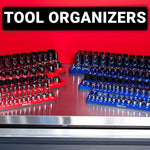
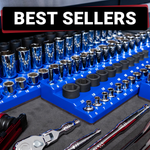
Sockets usually benefit from dedicated rails, trays, or grid-based retention systems. The right choice depends on how often you swap sets and whether you prioritize density or visibility. Rails can be compact and easy to reconfigure, while trays can make sizing more obvious at a glance. If you work with standard, metric, shallow, deep, chrome, and impact sockets, visibility becomes a big deal fast.
Wrench drawers
Wrenches need fast size identification and clean spacing. If they overlap too much, you end up flipping through them like cards every time you need one. A wrench organizer that keeps sizes aligned and readable saves time every single day. This is one of the easiest drawers to improve because the problem is usually obvious and the gain is immediate.
Pliers, cutters, and pry tools
These tools are awkward by nature. They vary in handle shape, jaw size, and length. Generic drawer liners alone will not control them well. They need separation so they do not tangle or stack into a pile. Adjustable organizers or modular systems often work best here because they handle mixed shapes better than fixed trays.
Precision and specialty tools
Torque tools, test equipment, picks, and specialty service tools deserve more protection than a catch-all drawer. These are the tools that get expensive fast and can be more sensitive to impact or poor storage. For this category, a more customized layout usually pays off.
Common organizer types and the trade-offs
There is no single best answer for every toolbox. It depends on the drawer, the tool type, and how often you rework your setup.
Foam layouts look clean and make missing tools obvious. They are great if your tool inventory is stable and you want maximum visual control. The downside is flexibility. When you add or replace tools, foam can become outdated quickly unless you are willing to cut and rework it.
Plastic trays and fitted organizers are simple, durable, and easy to drop into a drawer. They work especially well for sockets, screwdrivers, and wrenches. The trade-off is that fixed-size trays do not always make the best use of every drawer, especially if your box dimensions are unusual.
Rails are compact and efficient, especially for sockets. They let you move sections around and adapt to changing sets. But depending on the retention style, they may not be ideal for every mobile or high-vibration environment.
Modular grid systems give you strong flexibility. You can build around the exact tool shapes you own and expand as your collection grows. They take more planning on the front end, but they tend to be one of the smarter long-term choices for users who want a pro-level layout without being locked into one tray shape forever.
How to build a setup that actually improves workflow
Start with your most-used drawer, not the whole box. That keeps the project manageable and gives you a faster return. For most mechanics, that means sockets, ratchets, wrenches, and pliers first. If you fix the drawers you open 50 times a day, you will feel the difference right away.
Next, organize by task frequency, not just by tool family. Put the tools you grab together near each other. If your common brake tools live in three different drawers, your box is making you work harder than it should. A clean system is good. A system built around real workflow is better.
Measure your drawers before buying anything. That sounds basic, but skipped measurements are the reason many organizers end up jammed in, leaving dead space around the edges. Knowing usable width, depth, and clearance avoids frustration and helps you mix organizer types more effectively.
Then be honest about growth. If your tool collection is still expanding, a highly fixed layout may look good now but become limiting fast. A modular setup can be a better value over time because it adapts with your box instead of forcing you to start over.
Where people waste money
The most common mistake is buying cheap organizers twice. Thin materials, poor retention, and bad fit usually show up fast in daily use. What looked like savings turns into drawer clutter again in a few months.
Another mistake is over-organizing low-priority drawers while the main working drawers stay messy. If your electrical drawer looks perfect but your socket drawer is still chaos, the setup is backwards.
Some users also chase showroom looks over real function. Clean lines are great, but not if the layout slows you down, limits access, or leaves no room for the tools you use most. A tool drawer organizer system should earn its space every day.
What pros should look for before buying
Durability comes first. Organizers need to handle repeated use, drawer movement, grease, grime, and weight without warping or breaking down. Materials matter more in a working environment than they do in a hobby setup.
Look for systems that make sizing visible and tool retrieval fast. That sounds obvious, but some organizers hold tools securely while making them awkward to grab. Good retention should not come at the cost of speed.
Also think about whether the system can scale across multiple drawers. If you are building out a full box, consistency helps. It reduces visual clutter and makes future changes easier. This is where mechanic-focused systems from brands like Olsa Tools stand out - they are built around real drawer use, not just shelf appeal.
The right setup does not need to be fancy. It needs to save time, protect tools, and hold up to real work. If your drawers are slowing you down right now, the fix is probably simpler than you think. Start with one drawer, build it around your actual workflow, and let your box start pulling its weight for a change.