






A messy box costs you twice - once when you buy duplicate tools, and again every time you stop mid-job to hunt for the right socket. If you want to know how to organize mechanic tools in a way that actually saves time, start by treating organization like part of the repair process, not an afterthought.
Good organization is not about making a toolbox look pretty. It is about speed, consistency, and not losing money to wasted motion. In a busy shop, on a service truck, or in a home garage that sees regular work, the best setup is the one that lets your hand go to the right tool without thinking.
How to organize mechanic tools for real workflow
The biggest mistake most people make is organizing by whatever fits where. That feels productive for a day, then falls apart as soon as the next brake job, suspension job, or electrical repair starts mixing tools back together.
A better system follows workflow. Put tools together based on how you use them, then refine by size and type. That means your sockets, ratchets, extensions, and torque tools should live in a layout that supports fast handoff during actual work. Pliers should be grouped by function, not scattered between random drawers. Electrical tools should stay together because electrical work already slows down enough without a search party.
Think in zones. One zone for drive tools and sockets. One for wrenches. One for pliers and cutters. One for striking and pry tools. One for diagnostics and electrical. One for specialty tools you do not need every hour but do need to find fast when the job calls for them.
This approach works whether you have a full roll cab, a service cart, or a compact mobile setup. The size changes. The logic does not.
Start by cutting the clutter
Before you buy a single organizer, empty the drawer, cart, or box and make decisions. Broken tools, duplicate pieces you never touch, worn-out cases, loose fasteners, random hardware, and non-tool junk all steal space from tools you actually use.
Be honest about frequency. If you grab a 10mm socket ten times a day, it earns premium placement. If a specialty puller only comes out once every few months, it does not belong in your top drawer. A lot of disorganization comes from treating every tool like it deserves front-row access.
You also want to separate complete sets from orphaned pieces. Loose sockets and mixed-drive strays create chaos fast. Group what belongs together, then identify what is missing. A clean system is easier to maintain when every slot has a purpose.
Build your layout around priority
The top drawers and easiest-reach areas should hold your highest-use tools. That usually means ratchets, sockets, combination wrenches, screwdrivers, picks, pliers, and frequently used specialty tools. Heavier and less-used items can move lower.
Weight matters more than people think. Put your dead blows, pry bars, pullers, impact accessories, and bulkier items in lower drawers or stable side storage. Not just for convenience, but for safety and drawer life. A top-heavy box is annoying at best and a problem at worst.
If you work from a service cart during active jobs, treat that cart as your front line. Only keep daily-use tools there. Overflowing carts turn into portable junk drawers fast. Your main storage should support the cart, not duplicate it badly.
Organize sockets so they stay organized
Sockets are usually the first place a tool setup goes sideways. They are small, easy to mix, and impossible to grab quickly when they are piled together. If your socket drawer is a heap, every repair takes longer than it should.
Separate by drive size first - 1/4-inch, 3/8-inch, and 1/2-inch. Then break them into shallow, deep, standard, metric, SAE, chrome, and impact as needed. The exact split depends on your work. A tech doing mostly modern automotive work may give more space to metric. Someone working across equipment types may need a stronger SAE presence. That is where organization becomes practical instead of theoretical.
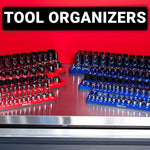
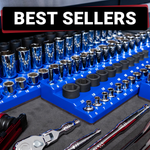
Use fixed-position organizers or trays that keep each socket visible and upright. The goal is instant identification. You should be able to spot the missing size immediately and return tools without thinking about it. That is one reason organization systems matter - they remove decisions from routine tasks.
Keep your most-used socket families closest to your ratchets and extensions. That sounds obvious, but a surprising number of boxes make you reach across multiple drawers to build a basic setup.
Keep wrench storage flat, visible, and consistent
Wrenches waste time when they overlap, slide, or disappear under each other. Stacking them loose in a drawer turns a simple grab into a fan-and-search routine. That is not efficient in any environment.
The best wrench setup keeps sizes visible in order and separated by type. Combination wrenches should stay in sequence. Stubby sets, ratcheting sets, flare nut wrenches, and specialty angled sets need their own home. Mixing them together because they are all technically wrenches is how drawers get messy again.
Vertical or angled wrench organizers work well because they make size gaps obvious. Flat layouts can also work if the drawer is shallow and the set stays contained. What matters is fast visibility and easy return.
Pliers, screwdrivers, and hand tools need function-based grouping
Pliers are one of the easiest categories to organize badly. Needle nose, slip joint, hose clamp pliers, locking pliers, cutters, crimpers, and snap ring pliers all do different jobs. Store them by function, not by handle color or drawer leftovers.
The same rule applies to screwdrivers and picks. Keep standard, Phillips, Torx, precision drivers, and striking-cap drivers sorted in a way that matches the kind of work you do most. If trim work, interior jobs, and electrical diagnosis are common, your finer hand tools need quick access. If heavy mechanical work dominates, your core grab tools should lead.
A drawer that holds all small hand tools can work, but only if the layout is strict. Once tools start rolling or crossing lanes, the system breaks down.
Specialty tools should be easy to find, not in the way
Specialty tools create a real trade-off. They are not daily grabs, but when you need them, you usually need them now. That means they should be clearly grouped and labeled, but not parked where your everyday tools belong.
Keep specialty tools together by task: brake service, pullers and separators, engine timing tools, electrical testing, trim removal, or torque-angle related work. If they came in molded cases and those cases actually protect the tool and stack well, keep them. If the case is oversized and wastes half a drawer, it may be smarter to rehome the tool into a better storage system.
For mobile mechanics, compactness matters more. You may need to store specialty tools in modular kits that can be grabbed per job instead of carrying every niche tool to every call.
Labeling is not overkill
If multiple people use the same box, cart, or shop area, labels save arguments and missing tools. Even if you work alone, labels make resets faster. They also help expose weak spots in your layout.
Foam cutouts, drawer labels, and clearly defined sections make it obvious where tools belong. That is especially useful for sockets, torque tools, and specialty items that should not get tossed into open space. The goal is not decoration. The goal is control.
This is where purpose-built organization systems earn their keep. A well-designed socket organizer or drawer grid does more than hold tools. It protects your layout from collapsing during a busy week.
Maintenance is part of the system
Once you figure out how to organize mechanic tools, the next challenge is keeping them that way. No system survives if you only reset it once a year.
Do a quick end-of-day reset. It takes a few minutes and prevents a full rebuild later. Wipe down dirty tools before they go back. Check for missing pieces before the next shift. If one drawer keeps turning into a mess, do not ignore it. That usually means the category is too broad, the organizer is wrong, or the tool count outgrew the space.
It is also worth reviewing your setup every few months. Work changes. Tool collections grow. New specialties creep in. A layout that made sense last year may be slowing you down now.
A strong organization system should feel almost boring. You open the drawer, the tool is there, and the job keeps moving. That is the standard. Built tough beats built fancy every time, and the right setup should do exactly what your tools are supposed to do - work hard, stay ready, and get out of your way.