







A deep 10mm that disappears in a full drawer can waste more time than a bad ratchet. If you're figuring out how to organize deep sockets, the goal is simple: see every size, grab the right one fast, and put it back without thinking twice. A good setup cuts down search time, keeps your drawer cleaner, and makes the whole bay run smoother.
Deep sockets are harder to manage than shallow ones for one reason: they take up more vertical and horizontal space, and they tend to roll, tip, or get mixed in with impact and standard sets. Toss them in a drawer and they become clutter fast. Organize them the right way, and they become one of the easiest tool groups to maintain.
How to organize deep sockets without wasting drawer space
Start by separating your sockets before you buy or rearrange any storage. Mixing drive sizes, measurement systems, and socket types is where most drawer chaos begins. Keep 1/4-inch, 3/8-inch, and 1/2-inch drive deep sockets in distinct groups. Then split SAE from metric. If you use both chrome and impact sockets, those need their own lanes too.
That first sort tells you how much space you actually need. A tech with one complete metric 3/8-inch deep set needs a different setup than someone carrying full SAE and metric sets across multiple drive sizes. If you skip this step, you usually end up forcing sockets into a storage solution that almost works but never stays clean.
The next decision is location. If the sockets live in a service cart top drawer, speed matters most. If they stay in a main box, capacity may matter more. Mobile mechanics and field techs also have to account for movement. A setup that looks neat in a stationary shop may turn into a jumbled mess on the road.
Choose the right deep socket organizer for your workflow
There is no single best answer for every shop. The right organizer depends on how often you use the set, how much drawer depth you have, and whether your tools stay put or travel.
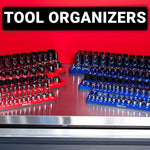
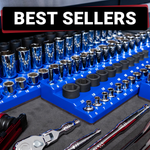
Socket rails are a strong option when you want a compact footprint and quick visual size checks. They work especially well for deep sockets because each piece has a dedicated spot, and you can group by drive size and measurement system without wasting space. A good rail setup also makes it obvious when something is missing before a job gets held up.
Magnetic organizers are excellent in drawers and carts where tools see regular movement. They hold sockets in place, reduce sliding, and keep rows readable. For deep sockets, that extra retention matters. Taller sockets shift more easily than shallow ones, so a magnetic base can make the difference between organized and scrambled.
Tray-style organizers make sense if you want the size marking laid out clearly and prefer a fixed home for every socket. They are easy to maintain in a shop environment where multiple people may use the same box. The trade-off is that trays can take up more drawer width, and some deep sockets may need a taller drawer than you expect.
Vertical organizers can save serious space, especially for larger deep impact sockets. But they are more situational. In a shallow drawer, they may not fit. In a mobile setup, vertical storage can work great if retention is solid. If not, it becomes frustrating fast.
For many mechanics, the best answer is not one organizer but a combination. High-use deep metric sockets might belong in a front drawer on a magnetic organizer, while backup SAE sizes can stay on rails in a secondary drawer. That kind of setup matches real use instead of forcing every socket into one system.
Build a layout that makes sense at a glance
Once you have the right organizer style, the layout matters just as much as the storage itself. Put your most-used deep sockets where your hand naturally goes first. For many techs, that means metric 3/8-inch drive deep sockets in the front half of a top drawer, followed by 1/2-inch drive and then SAE.
Keep sizes in strict order from smallest to largest. That sounds obvious, but plenty of drawers drift into loose grouping instead of true sequencing. Loose grouping slows you down because your eyes still have to hunt. Strict order removes that friction.
If you use duplicates, decide which one is the working socket and which one is the spare. The working socket gets the primary position. The spare should not sit randomly nearby. It needs its own marked spot or a separate overflow area. Otherwise, duplicates create visual noise and make missing sizes harder to notice.
Labels help more than most people think. If your organizer has stamped or printed size markers, keep them visible. If not, add simple labels to the drawer or organizer lane. This matters even more for mobile crews, shared workspaces, or anyone training newer techs.
Separate deep sockets by use, not just by size
One mistake people make when learning how to organize deep sockets is stopping at size order. Size matters, but use matters too.
If you regularly switch between chrome and impact sockets, keep them physically separated even if the sizes match. Mixing them might save a few inches, but it costs time and raises the chance of grabbing the wrong socket in the middle of a job. The same goes for specialty deep sockets, thin wall options, and lug-related sockets. They should be close to the work area where they are used, but not mixed into your standard daily set.
This is where honesty about your actual workflow helps. If a full SAE deep set only gets touched once a month, it should not occupy premium front-drawer real estate. Give top access to the sockets that earn it. Everything else can live one drawer lower or in a secondary box.
That approach keeps your layout lean. It also makes maintenance easier because the most-used tools are not buried under the least-used ones.
Keep deep sockets from getting mixed up again
A good system falls apart if it is hard to maintain. The best deep socket organization setup is one you can reset in seconds.
Start by giving every socket one home. Not a general area. One home. If a socket can land in two or three places, it eventually will. Dedicated positions are what keep the system tight.
Next, leave a little space around each group. Overpacked drawers are the enemy of consistency. If sockets have to be jammed back into place, people stop doing it right. A bit of breathing room makes return quick and natural.
It also helps to do a fast end-of-day reset. This is not a full inventory check. It is a 30-second look at the drawer before you close up. Missing sizes stand out immediately when the organizer is laid out well. That habit saves you from starting the next morning already behind.
For busy shops, drawer liners can help reduce movement, but retention still matters more. Deep sockets are tall and heavy enough to shift around if the organizer is weak or the drawer gets slammed. Built-for-the-job storage systems hold up better over time, especially in work trucks and service carts.
Common mistakes when organizing deep sockets
The biggest mistake is combining deep and shallow sockets in the same run just because the sizes match. It looks efficient at first, but it slows visual scanning and usually wastes space. Keep them separate.
The second mistake is ignoring drive size. A mixed row of 3/8-inch and 1/2-inch drive deep sockets creates constant hesitation. Your hand pauses, your eyes double-check, and the whole point of organization gets lost.
The third is buying storage based only on capacity. More capacity is not always better. If the organizer is awkward to read, hard to reload, or unstable in a moving cart, it will not stay organized. Practical speed beats theoretical storage every time.
A final mistake is treating organization like a one-time cleanup. Real tool control is part of workflow. If your setup does not support grab-use-return without effort, it will slowly fail.
A simple standard that works in real shops
If you want a setup that works for most mechanics, use this standard: separate by drive size, split metric and SAE, keep deep sockets apart from shallow, separate chrome from impact, and store daily-use sets in the most accessible drawer space. Then use an organizer with enough retention to keep everything in place when the drawer moves.
That formula is not flashy, but it works. It is fast to read, easy to maintain, and tough enough for daily use. For serious shop organization, that is the standard worth aiming for.
A clean socket drawer does more than look good. It keeps jobs moving, helps you spot missing tools before they become a problem, and cuts the kind of wasted motion that adds up all week. If your current setup makes you hunt, reshuffle, or guess, fix it now and make every pull count.