






A messy top drawer costs you more than space. It costs minutes on every job, extra reach, repeat movement, and that low-grade frustration that builds up when the 10mm, pick set, or test light never seems to be where it should be. The best toolbox drawer organizers fix that problem at the source by turning a drawer full of loose tools into a layout you can trust.
If you work out of a service bay, a mobile rig, or a home garage that gets used like a real shop, drawer organization is not cosmetic. It is workflow. Good organizers help you spot missing tools fast, protect what you own, and keep the tools you use most exactly where your hand expects them to be.
What makes the best toolbox drawer organizers actually worth buying
Not every organizer earns drawer space. Some look tidy on day one, then shift, crack, or waste more room than they save. The best systems do three things well. They hold tools securely, they fit the way real mechanics work, and they make the drawer easier to use instead of more complicated.
Security matters because drawers get opened hard and shut harder. If sockets, pliers, or screwdrivers slide out of place every time the box moves, the organizer is not solving the problem. Fit matters because a clean layout on paper means nothing if it cannot handle deep sockets, stubby ratchets, oddball pliers, or the tools you grab ten times a day. Ease of use matters because speed is the whole point. You should be able to spot, grab, and return a tool without thinking about it.
The best organizer for one drawer may be the wrong choice for the next one. A shallow drawer with precision tools needs a different setup than a deep drawer full of impact sockets and pry bars. That is why the right answer is usually a system, not one universal tray.
Best toolbox drawer organizers by tool type
The fastest way to organize a box is to match the organizer to the tool category. Mixed storage sounds flexible, but it usually turns into drift. Over time, the drawer becomes a catch-all again.
Socket organizers
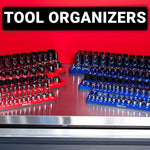
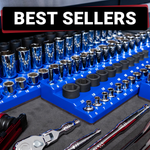
Sockets are one of the easiest categories to lose control of because they are compact, heavy, and easy to mix across drive sizes, lengths, and measurement systems. A strong socket organizer keeps rails or posts rigid, labels sizes clearly, and gives each socket a dedicated home. That dedicated spot is what lets you see immediately what is missing before a job or after one.
For mechanics, visibility matters as much as capacity. If you need to read size markings on every socket to find what you need, the drawer is still slowing you down. Good socket organization puts the right drive size, length, and metric or SAE grouping in a consistent order that becomes muscle memory.
Wrench organizers
Loose wrenches stack badly, hide the sizes you need, and turn even wide drawers into a pile. A proper wrench organizer separates each piece enough to identify it quickly while still packing the set efficiently. Vertical or angled systems can save space, but only if the drawer depth and clearance are right.
This is one of those areas where it depends on your workflow. If you use a complete set every day, a fixed-size organizer with clear labeling makes sense. If your wrench drawer changes often with specialty pieces, a modular system may hold up better over time.
Screwdriver and plier organizers
These tools create clutter differently. They are long, awkward, and prone to overlap. Simple partitions can work, but purpose-built organizers do a better job of keeping handles aligned and tips from tangling together. In a high-use drawer, that means less digging and fewer tools piled on top of each other.
The trade-off is density. Some organizers give every tool more breathing room, which improves speed but reduces total capacity. If your box is already tight, you may need to decide whether that drawer should prioritize speed or storage volume.
Modular grid and custom-fit systems
For mixed hand tools, modular systems are often the strongest option. They let you build around the actual shape of your tools instead of forcing everything into generic compartments. That matters when you have unusual pliers, electrical tools, torque tools, or a drawer built around a specific service routine.
This kind of setup takes more planning up front, but it usually pays off in control. Once each tool has a repeatable home, the drawer stays organized with less effort. For serious users, that consistency is the whole game.
How to choose the best toolbox drawer organizers for your box
Start with the drawer, not the product. Measure width, depth, and usable height. Some organizers look compact until the drawer will not close over a ratchet head or screwdriver handle. Low-profile designs are usually the safer move in shallow drawers, especially near the top of the box.
Next, look at tool frequency. Put high-use tools in the easiest drawers to reach and give them the cleanest layout. The tools you touch every day deserve the best real estate. Specialty tools you use once a month can live in denser storage lower in the box.
Then think about growth. A drawer packed to perfect capacity today can become a problem the minute you add one more socket rail, a long flex-head ratchet, or a second set of pliers. The best setups leave a little room for expansion without turning that space into a junk zone.
Material matters too. Plastic can be light and affordable, but not all plastic holds up the same under shop use. Foam can look clean and protect tools well, but it is less forgiving if your layout changes often. Steel components bring durability, though they can add weight and may not suit every drawer configuration. Modular composite systems often land in the sweet spot if they are built well.
Common mistakes that ruin drawer organization
The biggest mistake is organizing by appearance instead of use. A drawer can look sharp and still make you slower if the layout ignores your actual workflow. If your most-used ratchet is tucked behind low-use specialty tools just because the drawer looks symmetrical, the setup is wrong.
Another mistake is mixing categories too early. Combination drawers seem efficient when space is limited, but they usually become crowded faster and are harder to maintain. It is better to give sockets, wrenches, pliers, and drivers their own zones whenever possible, even if that means reorganizing the whole box in stages.
Overfilling is just as common. When tools are wedged into a drawer with no clearance, organizers stop doing their job. Tools bind, labels disappear, and returning a tool becomes a chore. Good organization lowers friction. If putting tools back feels annoying, the system will fail over time.
The last mistake is ignoring movement. A stationary shop box and a mobile service setup do not behave the same way. If your box gets rolled, loaded, or transported often, tool retention becomes much more important. What works fine in one bay may become a rattling mess in a truck.
When modular systems beat generic trays
Generic trays have their place. They are quick, simple, and useful for low-priority drawers or odd accessories. But for serious mechanics, they often top out fast. They leave dead space, they do not scale well, and they rarely handle varied tool shapes cleanly.
A modular system gives you more control. You can build around actual inventory, separate tools by task, and refine the layout over time as your work changes. That is especially useful if your box supports multiple kinds of jobs, from standard maintenance to electrical diagnostics and heavier mechanical work.
This is where purpose-built organization brands stand out. Systems designed specifically for sockets, wrenches, and drawer layouts tend to reflect real shop habits instead of generic storage logic. Olsa Tools has built a strong reputation around exactly that kind of mechanic-first organization, with solutions that aim to speed up access and keep drawers working hard, not just looking neat.
How to set up a drawer so it stays organized
The best toolbox drawer organizers still need a smart layout. Put your most-used tools in the front half of the drawer where access is fastest. Group by task when that makes more sense than grouping by tool family. For example, if certain pliers, picks, and trim tools always get used together, keeping them in one service drawer may beat separating them by category.
Labeling helps, but the bigger win is consistency. Once you choose a location for a tool, keep it there. Do not let one empty slot become temporary parking for random pieces. That is how organized drawers start drifting.
It also helps to audit the drawer regularly. If a tool has not been touched in months, it may not belong in prime space. If a tool keeps getting set on top of the organizer instead of returned to its slot, that is a sign the layout needs work. Good organization is practical, not permanent.
The right setup should make the start and end of every job cleaner. You open the drawer, see what you need, grab it fast, and know where it goes when the work is done. That is what the best drawer organizers are really buying you - less wasted motion, fewer missing tools, and a box that works as hard as you do.
A solid drawer layout will not make you a better tech overnight, but it will remove one more thing that slows good work down. That is a win you feel every single day.