






Open a service drawer after a long week and the problem shows itself fast - deep impact sockets rolled out of place, sizes mixed, and the one you need somehow buried under the rest. An impact socket holder tray fixes that mess at the source. It keeps heavy sockets visible, sorted, and ready to grab, which matters when the job clock is running and your workflow depends on staying organized.
This isn’t just about making a toolbox look better. For mechanics, mobile techs, and serious DIY users, socket organization directly affects speed. Every extra reach, every second spent hunting for a missing size, and every socket that ends up in the wrong drawer adds friction to the day. A good tray removes that friction.
Why an impact socket holder tray matters
Impact sockets are different from standard chrome sockets in ways that affect storage. They’re heavier, often thicker-walled, and built for harder use. That extra weight is exactly why cheap organizers fail. A flimsy tray that works fine for light sockets can shift, crack, or turn into a loose pile once it’s loaded with impact sets.
A purpose-built impact socket holder tray gives each socket a defined home. That sounds simple, but in a real shop it does three important things. First, it makes missing sockets obvious. Second, it cuts down on drawer clutter that damages tools and wastes time. Third, it supports a cleaner system, which is what keeps a toolbox efficient month after month instead of just one afternoon after cleanup.
There’s also a safety and durability angle. Heavy sockets sliding around in a drawer can bang into each other, chip labels, and stress drawer liners. In a mobile setup, that movement gets worse. If your tools travel in a service truck or roll cart, storage has to hold up under vibration and constant motion.
What to look for in an impact socket holder tray
The right tray depends on how you work, where you store tools, and how often you add to your set. Still, a few features matter almost every time.
Fit for socket size and drive size
Start with the basics. Your tray has to match the sockets you actually use. That means paying attention to drive sizes like 1/4-inch, 3/8-inch, 1/2-inch, and 3/4-inch if your setup goes bigger. It also means considering whether your collection is mostly shallow, deep, or a mix of both.
Some trays handle a broad range well, while others are tighter and more specialized. Specialized can be better if you want a cleaner fit and tighter organization. But if your drawer has to carry mixed sets or you’re still building out your socket lineup, a little flexibility can save you from outgrowing the tray too soon.
Material strength
This is where a lot of organizers separate fast. Impact sockets are not light-duty tools, so the holder tray shouldn’t be light-duty either. Look for construction that can handle loaded weight without bowing, cracking, or losing shape over time.
Material choice also affects how the tray behaves in a real shop. If it’s going in a box that sees daily use, dropped sockets, dirty hands, and occasional fluid exposure, durability matters more than appearance. Tough polymer and solid magnetic designs both have their place, but the key is whether they’re built for repeated abuse.
Retention and stability
Not every tray secures sockets the same way. Some focus on open, easy-access placement. Others use stronger retention so sockets stay put during transport. Neither approach is automatically better. It depends on your workflow.
If you work from a stationary tool chest and want the fastest grab-and-go access, open organization can make sense. If your tray lives in a service truck, roll cart, or frequently moved drawer, stronger socket retention and anti-slip stability become much more important. The more your tools move, the more your organizer needs to resist that movement.
Clear size visibility
A tray should help you find the right socket fast, not create another layer to sort through. Size markings need to be easy to read at a glance. Good visibility matters even more when you’re working under pressure, low light, or greasy conditions.
This is one of those details people overlook until they use a bad organizer for a month. If labels wear off, blend in, or get blocked by socket placement, you lose part of the point. The best tray makes socket selection nearly automatic.
Drawer tray or rail-style holder?
When people shop for socket organization, they often compare trays and rails. Both can work well, but they solve different problems.
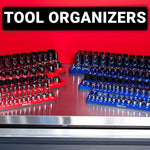
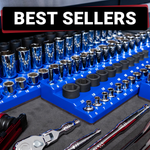
A tray is usually the better choice when you want a stable drawer layout with immediate visual inventory. You open the drawer, see every size, and know right away what’s missing. It’s clean, efficient, and ideal for mechanics who want a repeatable setup in a box or cart.
Rails can be useful when portability matters more or when drawer space is limited in a different way. They can also work well for small subsets of sockets used for specific jobs. But for full-set organization, especially with impact sockets, a dedicated tray often gives you better spacing, better visibility, and less drawer chaos.
How to match the tray to your workflow
For shop drawers and service bays
If your tools stay in one main box, focus on visibility and layout first. You want a tray that lets you spot sizes instantly and keeps your drawer looking the same every time you open it. Consistency matters. When every socket goes back to the same slot, tool control gets easier and the whole box becomes faster to use.
In this setup, tray footprint is a big factor. Measure drawer depth and width before you buy. A tray that wastes space or forces awkward placement can create a new problem instead of solving one.
For mobile mechanics and field service
Movement changes everything. A mobile setup puts more stress on organizers than a stationary box ever will. Vibration, road travel, quick stops, and frequent drawer opening all test retention.
For this kind of work, an impact socket holder tray needs to stay planted and keep sockets under control even when the vehicle doesn’t. Strong magnetic hold, secure posts, or a design built for transport can make a real difference. A tray that performs well in a garage may not perform the same way on the road.
For serious DIY users building a better system
If you’re upgrading from loose sockets in a drawer or coffee can storage, almost any dedicated tray will feel like a major improvement. But it still pays to think ahead. Buy based on the set you want to own, not just the set you have today.
If you know you’ll add deep sockets, larger drive sizes, or both SAE and metric, choose an organizer system that gives you room to grow. The goal is to build order once and keep it, not reorganize every few months.
Common mistakes when buying an impact socket holder tray
The first mistake is buying only for appearance. A clean tray looks great on day one, but if it can’t handle weight, grime, and regular use, it won’t stay clean for long.
The second is ignoring drawer dimensions. Even a well-made organizer becomes frustrating if it doesn’t fit the space correctly or blocks other tools you use every day.
The third is choosing a tray without thinking about socket count. If the organizer can’t hold your full working set, you end up splitting sockets across multiple places. That defeats the point of better organization.
Another common miss is forgetting about access speed. Some retention systems hold sockets tightly, which is good for movement, but can slow you down if removal takes too much effort. There’s always a trade-off. The right balance depends on whether your top priority is transport security or fastest possible access.
A better setup pays off every day
A well-built impact socket holder tray does more than organize metal in a drawer. It protects your time. It sharpens your workflow. It helps you keep track of the tools that make you money or keep your projects moving.
That’s why organization products deserve the same attention as the tools themselves. If a socket set is built for serious work, the storage should be too. Olsa Tools puts a lot of focus on that exact idea - practical organization that works as hard as the tools inside it.
When your sockets have a fixed place, cleanup gets faster, missing sizes stand out immediately, and the next job starts without the usual search. That’s the kind of upgrade you feel every single day in the box, in the bay, and on the truck.